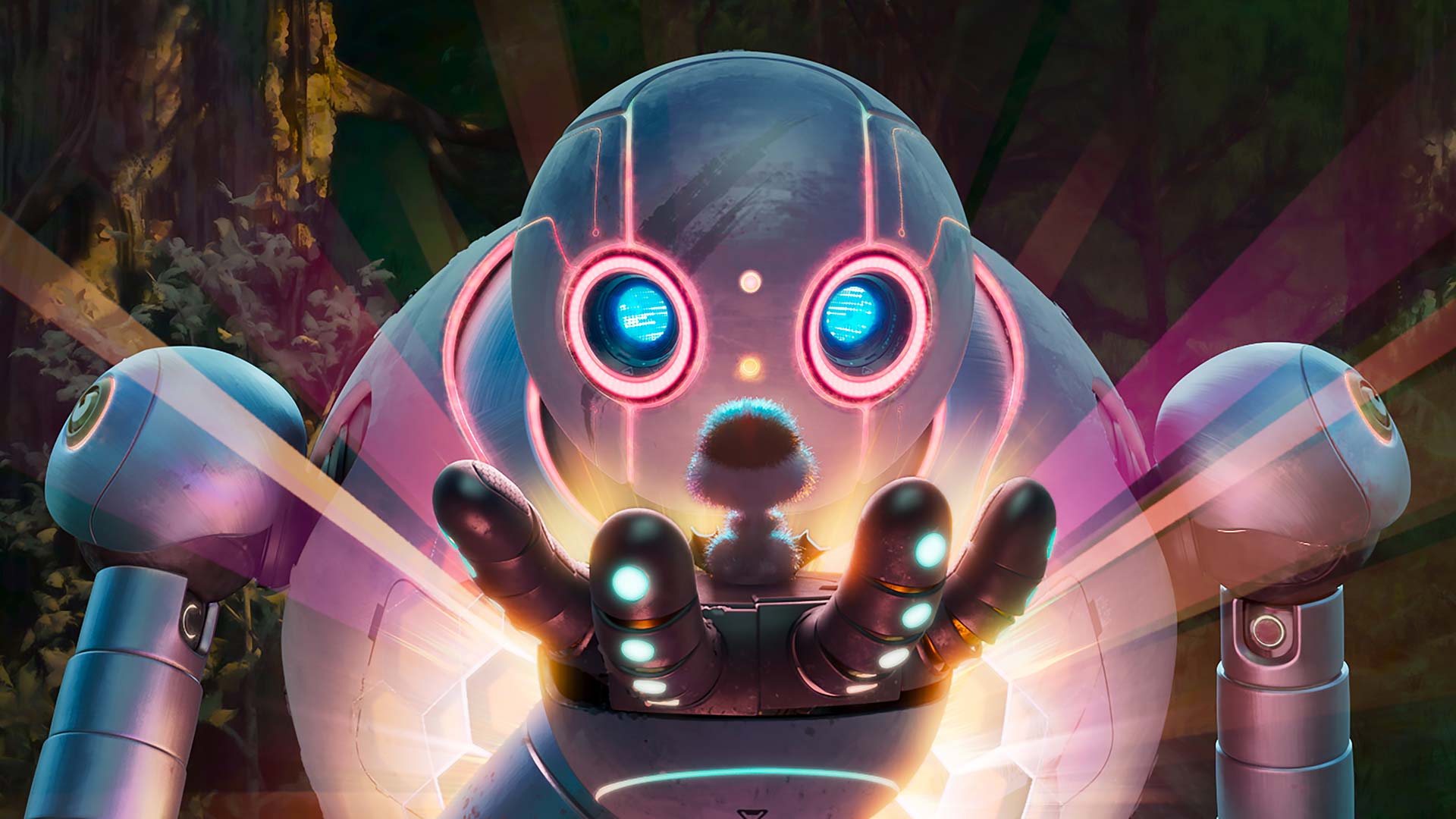
Disclaimer: This website is a personal platform dedicated to reviewing books and movies. Images from The Wild Robot movie, produced by DreamWorks Animation, are used here solely for commentary, critique, and review purposes, in accordance with the principles of fair use under copyright law. I do not claim ownership of these images, and they remain the property of DreamWorks Animation and its affiliates.
Robot Meets the Wild: Ridiculous . . . Right?
There’s something inherently absurd about the idea of a robot marooned on a remote island, befriending animals, and learning what it means to be alive. It’s the kind of premise that makes you pause mid-scroll, chuckle softly, and think, “Oh, that’s cool, I guess. But is it capable of emotionally eviscerating me at 2 AM?”
Spoiler alert: it will. And you’ll thank it for the heartbreak.

Adapted from Peter Brown’s comic book of the same name, The Wild Robot explores the story of Roz, a human-made automaton who washes up the shore of a deserted island following a hurricane. While she is busy calculating her next move, she realizes that the island is, in fact, not so deserted. Faced with a bustling ecosystem of curious raccoons, formidable bears, and judgmental birds, Roz is forced to grapple with challenges beyond her utilitarian programming.
Her journey takes an especially profound turn once Roz becomes the mother to Brightbill, a gosling who imprints on her after she inadvertently causes his family’s demise. This is the event that launches Roz into an emotionally raw exploration of questions about motherhood, sacrifice, and environmentalism.
Non-Human Characters That Feel Human
The entire story is told through the perspective of Roz, a humanized robot programmed for human convenience. At first, she’s hilariously out of place– a sleek machine dropped in the middle of the vibrant chaos of a jungle. Her rigid programming is no match for the messiness of nature or the complexities of motherhood. And it’s this very awkwardness– this constant bumbling effort to fit into an environment so alien to her design– that makes Roz such a compelling protagonist.

She begins the story as the classic “cold and emotionless” robot stereotype, but her journey subverts this trope in every way. Overcoming the challenges thrown in her way, Roz is kind to a fault, even to those who mock her. In one particularly heart-wrenching moment (no spoilers!), she risks everything to protect the same animals who once mocked her. By the end, Roz’s character development is so profound and emotionally resonant that you might just find yourself rooting for her as if she were flesh and blood.

Then there’s Brightbill, the young gosling Roz is tasked with taking care of, who embodies the universal struggles of adolescence: from the rebelliousness of his teenage years to his search for identity. Even when Brightbill learns Roz accidentally caused his parents’ death, the narrative handles the revelation with depth. It takes the chance to explore themes of teenage resentment and the difficult decisions parents often have to make. Overall, the audience is with him in every step of his character development, from being ostracized by the other birds to the scene where he learns to fly and lead, sprouting both metaphorical and literal wings.
Even minor characters like Fink the fox are given depth. Initially out to make a meal of Brightbill, Fink eventually steps up as an unlikely ally, delivering a rousing speech that unites the animals during a moment of crisis. These nuanced arcs for even the smallest characters highlight the story’s attention to detail and its insistence that no one, no matter how minor, is overlooked.
Themes
And don’t even get me started on the underlying messages from the film. Specifically, Roz’s journey as a mother is messy, layered, and achingly real. From sacrificing her own safety (and even her leg) to protect Brightbill to watching him spread his wings and “leave the nest,” her story captures what I’m sure is the universal experience of parenthood. It’s a visceral reminder that love often means letting go. And for children, the story offers an empathetic lens to understand their parents’ sacrifices and the messy, imperfect decisions that come with love.

Another particularly touching element are the choices people make to be kind, even to those who may not deserve it. Roz and Brightbill endure constant ridicule– for Roz’s robotic monotone and Brightbill’s unconventional upbringing. Yet Roz consistently chooses empathy. Her decision to save those who mocked her is one of the story’s most poignant moments, leaving me absolutely blown away.

Finally, this film had one of the most powerful messages about environmentalism that I’ve seen. Viewed through Roz’s lens, the story critiques humanity’s careless destruction of the natural world. The island’s vibrant life stands in stark contrast to the cold, unfeeling presence of humans in every way, urging us to think before we continue to ravage the beautiful natural world that keeps us alive.
A Feast for the Eyes and Ears
Finally, no review of The Wild Robot would be complete without raving about its stunning visuals and hauntingly beautiful score. The animation is stunning, brimming with life at every scene as it captures the life of the wilderness in lush detail– and juxtaposes greatly with Roz’s sleek, metallic design. Even the way her design eventually morphs stands as a visual symbol of her ultimate assimilation with the wild. Coupled with a beautiful musical score, the film truly made me feel alive, sending goosebumps down my arms and tears down my face.

Final Thoughts
Ultimately, this film is one of the rare stories that will change your worldview, leaving you astonished long after the credits roll. With achingly raw characters, human themes, and beautiful animation that balance comedy with emotional vulnerability, this film stole my breath away.
So yes, The Wild Robot will break your heart. But more importantly, it will also rebuild it piece by piece, with a profound message of what it means to live, to love, and to belong.

Leave a Reply